
Twenty drainage services, one phone number
Tallahassee Yard Drainage Services in Tallahassee
French drains, regrading, swales, catch basins, downspouts, pumps and erosion work. Each has its own page with how it works, when it fits and what it usually costs.
- Tallahassee, Bradfordville and Crawfordville
- Written price before any digging
- Licensed, insured local contractors
- Priced for Red Hills clay and karst sand
Tallahassee Yard Drainage arranges yard drainage work across Tallahassee, Bradfordville and Crawfordville through local contractors who do this work every week. Below is everything we handle, grouped by the job it does. If you are not sure which one your yard needs, that is normal. Most people call about a symptom, not a method.
Pick by what the water is doing
The quickest way to the right page is to describe the water. Water flowing across the surface is a grading, swale or catch basin problem. Water rising out of soggy ground is a French drain problem. Water coming off the roof is a downspout problem. Water with nowhere lower to go is a pump problem. Water carrying soil away is an erosion problem.
- Soggy ground: French drain installation, clay soil drainage
- Puddles and low spots: standing water fixes, catch basins
- Surface flow: yard grading, drainage swales, dry creek beds
- Roof water: downspout drainage, pop-up emitters, dry wells
Pick by where the problem is
- At the house: foundation drainage, crawl space drainage
- On hard surfaces: channel drains, driveway drainage, patio drainage, pool deck drainage
- On slopes and walls: erosion control, retaining wall drainage
- With no downhill: yard sump pumps
- Existing drains: French drain repair
Not sure which of these your yard needs? Describe it on the phone and get a straight answer.
Call (850) 604-5871How the prices on these pages work
Every service page shows a typical price range for Tallahassee. The ranges are there so you know roughly what you are walking into before you call, and they are honest ranges, not teaser numbers. Your written price depends on the length of the run, depth, soil, access, tree roots, how far it is to a legal outlet and whether any permit is involved. It is confirmed in writing before work starts.
Most real jobs combine two or three of these services. Downspout piping plus a French drain, or a regrade plus a swale, is more common than any single service on its own.
What every job has in common
Every trench starts with a Sunshine 811 utility locate, which needs at least two full business days of notice. Every drain needs a legal outlet: Florida's reasonable-use rule for surface water means it cannot simply be sent onto a neighbor. And anything that ties into a street, curb or ditch in the public right of way needs a permit from the City of Tallahassee, Leon County or Wakulla County, depending on the address.
Not sure which of these your yard needs? Describe it on the phone and get a straight answer.
Call (850) 604-5871Not sure which service you need?
Describe what the water does and where. You will hear which fix fits, and whether you need one at all.
Call (850) 604-5871Questions about drainage services
What does a yard drainage contractor do?
Finds where water comes from and where it can legally go, then builds the fix: grading, French drains, swales, catch basins, downspout piping, pumps or erosion repair.
How much does yard drainage cost in Tallahassee?
Most jobs run $2,500 to $9,000. Single downspouts start around $400; foundation drainage on a whole house can reach $12,000.
Which drainage solution is best for my yard?
It depends on the water: surface flow needs grading or a swale, soggy soil needs a French drain, roof water needs downspout piping, and a lot with no downhill needs a pump.
What are the signs my yard needs drainage work?
Water standing more than a day after rain, water at the foundation, mud on hard surfaces, soggy strips, gullies and downspouts dumping onto the lawn.
Do drainage contractors handle permits?
For right-of-way work, the contractor should pull the city or county permit. Ask who is pulling it before you sign.
Every service, with its own page
-
French drain installation
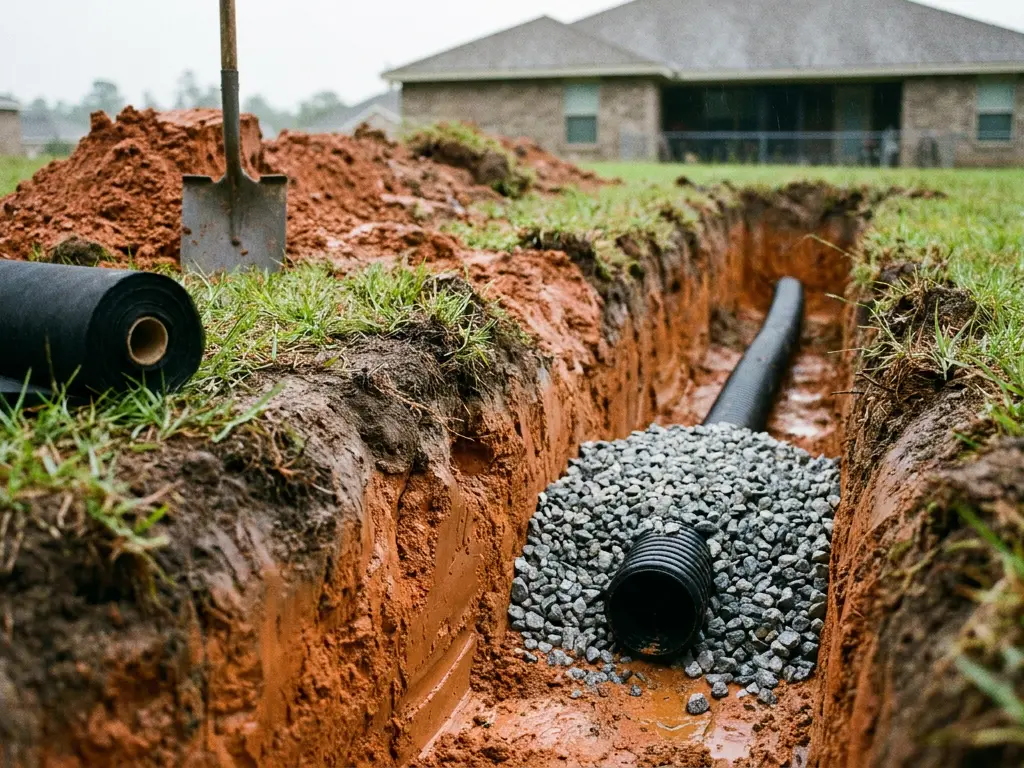
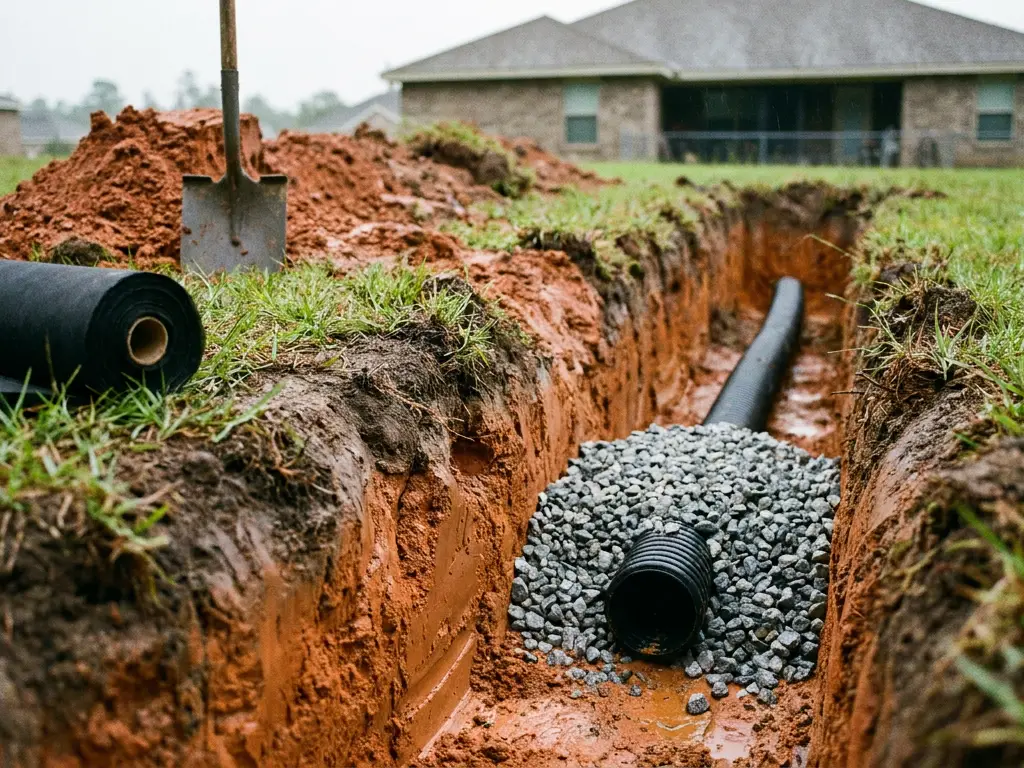
A gravel trench and perforated pipe that pulls water out of the ground and carries it somewhere it is allowed to go.
-
French drain repair
A French drain that used to work and now does nothing has usually failed in one of four ways. Finding which one decides whether it is a cleaning or a dig.
-
Standing water in the yard
A puddle that forms in the same spot every storm is telling you exactly where the problem is. The work is figuring out why it forms there.
-
Clay soil drainage
Red loam on top, clay-rich subsoil underneath. Water gets through the first and stops at the second. Fixing a soggy Red Hills yard starts with knowing that.
-
Yard grading
The cheapest drain is the one you never have to bury. Regrading reshapes the surface so rain runs away from the house and off the lot the way it should have from the start.
-
Drainage swales
A swale is a shallow, gently sloped channel in the lawn. It moves a summer storm's worth of surface water across a yard without a single buried part to clog.
-
Catch basins
When water collects in one spot and stays there, a catch basin gives it a door. The grate collects it at the surface and solid pipe carries it away.
-
Downspout drainage
Every downspout that dumps beside the slab is pouring a roof's worth of rain into the soil your foundation sits on. This is usually the cheapest fix on the list.
-
Pop-up emitters
The green cap in the lawn that lets a buried pipe release water. When it fails, everything upstream of it fails too.
-
Dry wells
A dry well stores storm water underground and lets it soak away slowly. In the right soil it is an elegant outlet. In the wrong soil it is a buried bucket.
-
Dry creek beds
A dry creek bed is a swale lined with river rock. It carries storm water where grass would wash out, and on a dry day it looks like it was always there.
-
Channel and trench drains
Where water runs across a hard surface toward a garage, a door or a patio, a channel drain catches the whole width of the flow in a single line.
-
Foundation drainage
The house is the one thing in the yard that must stay dry. Foundation drainage moves water away from it before it can soak the soil the slab rests on.
-
Yard sump pumps
Most drainage works by gravity. On a flat lot, or a yard lower than the street, gravity has nowhere to send the water. A pump lifts it out.
-
Erosion control
A gully in a Red Hills yard gets deeper every storm. Filling it is not enough. The water that cut it has to be slowed down or sent somewhere else.
-
Retaining wall drainage
Most retaining walls that lean, bulge or crack are failing because of water, not weight. Wet soil behind a wall pushes far harder than dry soil.
-
Driveway drainage
A driveway is a large, hard, sloped surface. Every drop that lands on it arrives somewhere fast, usually the garage, the lawn edge or the street.
-
Pool deck drainage
A pool deck is a flat hard surface next to a hole full of water, often next to a house. When drainage around it fails, it fails in three directions at once.
-
Crawl space drainage
Water under a house evaporates up into the floor framing. The fix almost always starts outside, and only sometimes needs a drain and pump underneath.
-
Patio drainage
A patio added after the house was built often blocks the path the yard's water used to take. The water does not stop coming. It just stops at the patio.
Talk it through before anyone digs
Describe where the water sits and where it comes from. You will hear which fix fits the yard, what it usually costs, and whether you need one at all.
Call (850) 604-5871