Tallahassee Yard Drainage French Drain Installation in Tallahassee, FL
Tallahassee Yard Drainage installs French drains across Tallahassee and the surrounding 35 miles of Leon, Wakulla, Gadsden and Jefferson counties. It is the most common recommendation made here, and the reason is geological rather than commercial: on Red Hills clay, giving water a route out is usually the only thing that works.
The short answer
A French drain is a sloped trench of washed stone wrapped in filter fabric with a perforated pipe at the bottom, and it works by offering water an easier path than the one it is currently taking. In Tallahassee that matters more than it does in most of Florida, because the dense clay under the topsoil here will not let water percolate down. The water is not looking for somewhere to soak in. It is looking for somewhere to go.
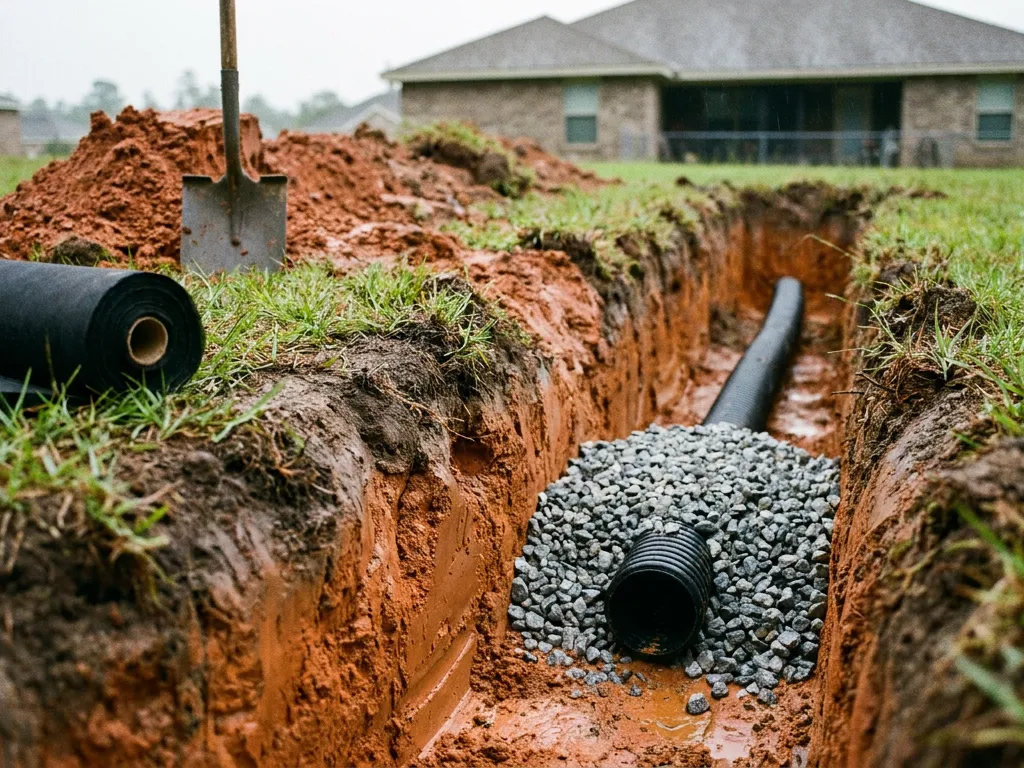
What a French drain is, and what it is not
It is not a ditch filled with rock, and it is not a pipe buried in dirt. The working part is a continuous fall from the wet end to the outlet, typically one percent or better, which is about an inch of drop for every eight feet of run. Everything else in the trench exists to keep that fall working for twenty years instead of two.
The pipe goes in with its perforations facing down, which surprises people who assume holes should face the rain. Water enters a French drain from below, through the stone column, after it has already travelled down through the soil. Holes pointing up collect silt from the top of the trench and little else.
Why the stone and the fabric matter more than the pipe
The backfill is washed angular stone, usually a number 57 size, because rounded pea gravel packs tight and clogs where angular stone locks together and leaves voids for water to move through. That void space is most of the drain's actual capacity. The pipe is the last few feet of the journey, not the whole of it.
Non woven filter fabric wraps the stone, separating it from the surrounding soil. In this area that separation is the single difference between a drain that still works in fifteen years and one that silts up in five, because Red Hills clay particles are fine enough to migrate into unwrapped stone and fill the voids from the inside. Fabric on the pipe alone, the so called sock, is not the same thing and is not a substitute.
Where the water is allowed to go
A drain is only as good as its outlet, and the outlet is the part that gets decided first, not last. On most lots that means a pop up emitter at a lower point, or the head of a dry creek bed. On lots with no fall available it can mean a basin and a pump, which is a different system with different running costs.
Discharging into a roadside ditch, a culvert or anything else in the county right of way is a fourth option and the one that brings paperwork with it, because that infrastructure belongs to Leon County or the City of Tallahassee rather than to the property. That gets established before the trench is dug rather than after.
The four ways a new drain fails early
Laid flat, so water stands in the pipe instead of moving. Built without fabric, so the stone silts in. Outlet placed level with or below the water it is meant to release, so the whole run backs up. Or sized for an average rain on a lot that sheds a great deal more than average.
All four are decisions made on the first day, and none of them announce themselves until a storm. This is why the site visit measures rather than estimates: the fall, the soil, the volume the roof and the slope actually deliver, and where the water can legally end up.
Signs this is your problem
- Water stands in the same place more than 24 hours after rain has stopped
- The lawn is still soft underfoot days after the yard next door has dried
- A strip of grass dies back along a line that follows no visible slope
- Regrading was done already and the wet spot came back
French drains: questions
How deep does a French drain need to be here?
Eighteen to twenty four inches covers most yard drains. A drain whose job is protecting a foundation goes deeper, down to footing level, because it has to intercept water before it reaches the wall rather than collect it afterwards. Depth is set on site, not from a catalogue.
Will a French drain work on a flat lot?
The trench needs fall even when the surface does not have any, and on a genuinely flat lot that fall gets cut into the trench itself, deepening along the run. Where there is no lower point anywhere to release to, gravity has run out and the honest answer is a basin and a pump instead.
How long does installation take?
A straightforward residential run is usually one to two days. Crossing a driveway, working around mature roots, or a multi branch system collecting from several points all add to that.
Does a French drain need maintenance?
Very little when it is built with wrapped stone and a clear outlet. Worth checking the outlet once a year and after any major storm, because a buried or blocked emitter will back up an otherwise perfect system.
Can it fix a damp crawl space?
Often, when the water is arriving from the yard rather than from plumbing or condensation. The tell is timing: dampness that tracks rainfall within a day is a drainage problem, dampness with no relationship to rain is usually not.
Do I need a permit in Leon County?
A drain that stays on your property and discharges on your property generally does not. One that ties into a roadside ditch, a culvert or a stormwater pipe generally does, because that is county or city infrastructure. It gets checked during planning either way.
Find out what is actually wrong
Describe where the water sits and how long it stays. The yard gets walked, the cause gets found, and a written price comes before anything is dug.
Site visits by appointment