Tallahassee Yard Drainage Catch Basin Installation in Tallahassee, FL
Tallahassee Yard Drainage installs catch basins across Tallahassee and within about 35 miles of the city. A basin is rarely a project on its own. It is the component that lets the rest of a system take in water arriving at one concentrated point rather than spread along a trench.
The short answer
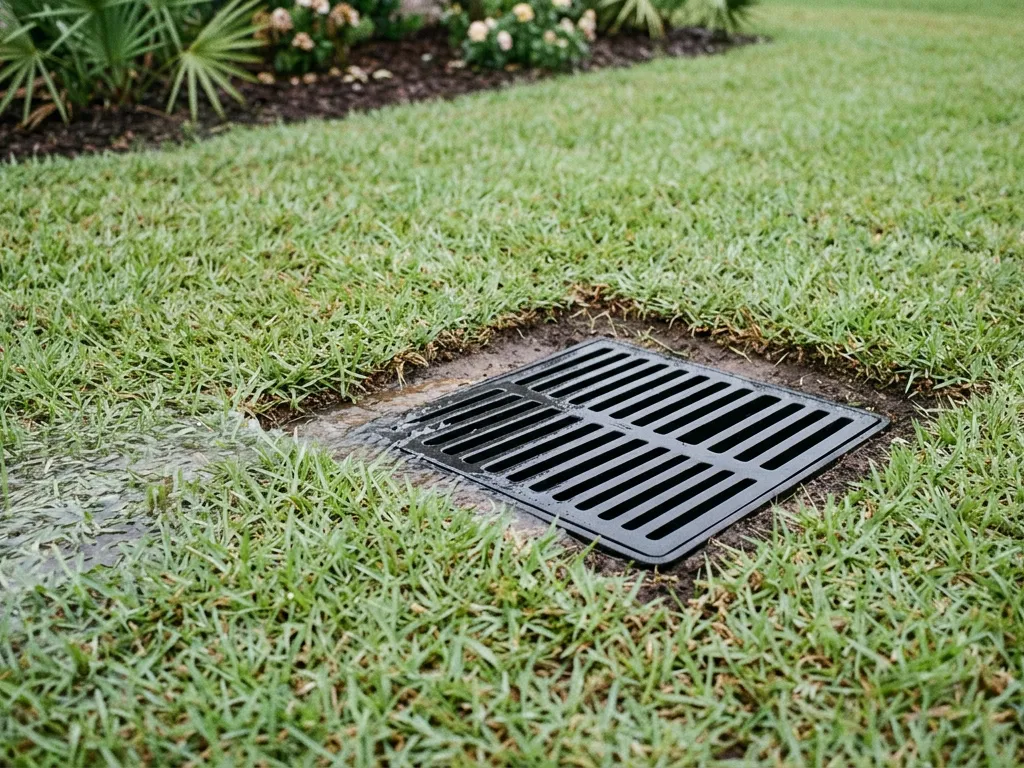
A catch basin is a grated box set flush into the ground at a low point, collecting surface water and handing it to a pipe. It is the component that lets a drainage system deal with water arriving at one concentrated spot, which a trench running along a line cannot do well. Most whole yard systems have at least one, and getting its position right is measured in inches rather than feet.
A drainage system needs a mouth
A French drain collects water spread along its length, slowly, through stone. That is the correct mechanism for groundwater and the wrong one for a courtyard, a patio corner or the bottom of a driveway, where a large volume of surface water arrives at a single point in a short time and needs taking in immediately.
The basin does that, and the sump beneath its outlet does the other half of the job: it gives leaves, grit and the sand that washes off a driveway somewhere to settle rather than being carried into the pipe. That is the part homeowners empty once or twice a year and the reason the pipe downstream stays clear.
Getting the low point right to the inch
The single most common fault with an installed basin is that it is near the low point rather than at it. Water finds the true low point with complete accuracy and will pool two inches away from a grate indefinitely. Where the low point is depends on the finished grade after the work, not the grade before it, which is why the basin is set during finishing rather than at the start.
On a lot with several collection points, the question is whether each one needs its own basin or whether a small amount of regrading can bring two of them into a single catchment. The second is generally cheaper to build and simpler to maintain.
Grates, loads and the driveway question
A basin in a lawn only has to survive being walked on and mown over, and a standard plastic grate handles that indefinitely. A basin in a driveway, a parking pad or anywhere a vehicle crosses needs a traffic rated grate and often a different basin body, and putting a pedestrian grate in a driveway is a failure with a predictable date on it.
Sizing follows the catchment rather than the fashion. A twelve inch basin serves a typical residential low point; larger catchments, long driveways and anything collecting roof water as well as surface water justify going up in size, because the basin should never be the narrowest part of the system.
Why basins silt up, and what to do about it
Every catch basin collects sediment, and that is the design working rather than failing. The sump below the outlet exists precisely so that grit, sand off a driveway and leaf litter settle there instead of travelling into the pipe, where clearing them is a far bigger job.
The maintenance follows from that. Lift the grate, scoop the sump, replace the grate, once or twice a year and after heavy leaf fall. It takes a few minutes and it is the difference between a basin protecting the system downstream and a basin quietly filling until it overflows at the surface during the first serious storm of the season.
A basin that silts up unusually fast is telling you something else: usually that bare soil or an eroding slope upstream is feeding it sediment continuously, and that the erosion is the problem actually worth fixing.
Signs this is your problem
- Water collects at one defined spot faster than it can soak away
- The foot of a driveway or a patio corner ponds after every storm
- An existing drain cannot take water in quickly enough during heavy rain
- Water needs collecting at a point rather than along a line
Catch basins: questions
Where exactly should a catch basin go?
At the true low point of the area it serves, established with a level against the finished grade rather than estimated by eye. Two inches off and water will sit beside the grate rather than run into it, which is the most common reason an installed basin appears not to work.
Can a basin go in a driveway?
Yes, with a traffic rated grate and a body rated for the load. This is not the same hardware as a lawn basin and substituting one for the other fails, usually the first time something heavier than a car crosses it.
How often does it need cleaning?
Lifting the grate and clearing the sump once or twice a year, and after heavy leaf fall, is generally enough. It takes a few minutes and it is the difference between a basin protecting the pipe downstream and a basin quietly silting into it.
How many does a yard need?
Usually one or two, placed at genuine collection points. More than that is worth questioning, because it can indicate that regrading to consolidate the catchments would be cheaper and less to maintain than adding hardware.
Can a catch basin connect to an existing French drain?
Yes, and it is a common upgrade when a drain is coping with groundwater but not with the surface water arriving at one spot. The basin is tied into the existing line, provided the line has the capacity for the extra flow.
Find out what is actually wrong
Describe where the water sits and how long it stays. The yard gets walked, the cause gets found, and a written price comes before anything is dug.
Site visits by appointment