Tallahassee Yard Drainage Dry Creek Bed Installation in Tallahassee, FL
Tallahassee Yard Drainage builds dry creek beds throughout the Tallahassee area. Underneath the stone they are swales, which is the part that decides whether they work, and they are worth considering whenever a drainage fix has to sit somewhere people will be looking at it.
The short answer
A dry creek bed is a drainage swale dressed in river rock. Built correctly it is a functioning channel that moves serious volume during a storm and reads as a landscape feature for the other three hundred and sixty days. Built as decoration, it is a strip of gravel that fills with weeds and moves water no better than the grass it replaced.
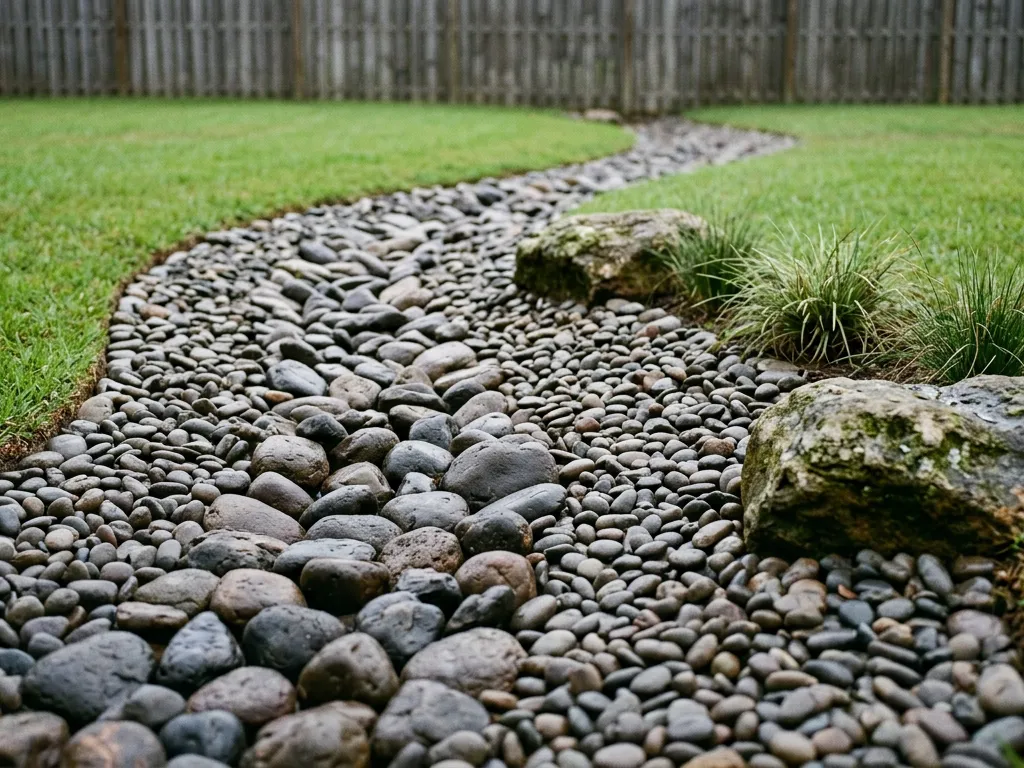
A working channel wearing a landscape feature
Everything structural about a dry creek bed is identical to a functional swale: excavated cross section, continuous fall to a defined outlet, geotextile separating stone from soil. The rock is the finish applied over working infrastructure, not a substitute for building any.
This is the easiest drainage element to get visually right and hydraulically wrong, which is why a bed that looks handsome and does nothing is such a common find. The question worth asking of any proposal is simple: where does it start, where does it end, and what is the fall between those two points.
Rock sizing is most of the craft
Graded stone, not one uniform size. Larger stone goes in the channel bottom and along the line of strongest flow where velocity is highest, with smaller decorative material toward the banks. That arrangement is simultaneously what stops the bed rearranging itself during a storm and what makes it look like a watercourse rather than a trench full of gravel.
Occasional larger boulders set into the banks break up the line and give the eye something to read, and plantings along the edge finish it. Neither affects drainage, which is worth stating plainly so the budget goes to the parts that do.
Fabric underneath is not optional here. Without it, Tallahassee's clay and silt work upward into the stone within a season or two and the bed stops looking clean, starts holding weeds and loses the void space that carries water.
What it asks of you afterwards
Less than grass, in the sense that it is never mown. More than grass, in the sense that weeds that seed into rock have to be pulled rather than cut, and stone that migrates during a heavy storm needs occasionally raking back. A bed with proper fabric and correctly graded rock is largely self maintaining; one built without either is a recurring chore.
Where a dry creek bed takes the discharge from a French drain, the junction is worth checking once a year, because that is where debris collects first and where a blockage backs up the system upstream of it.
What it costs relative to a buried drain
For the same length of run, a dry creek bed usually lands somewhere between a plain grass swale and a buried French drain. It needs the same excavation and grading as the swale, plus fabric and a meaningful quantity of graded stone, which is the bulk of the difference.
Where it genuinely saves money is on a lot that needs surface conveyance anyway. If water has to cross open ground to reach a discharge point, doing that in an open channel is cheaper than doing it in buried pipe sized for the same flow, and the rock finish costs less than the trenching and backfill it replaces. It is the wrong economy only when the water in question is underground, because then a bed on the surface has nothing to collect.
Signs this is your problem
- A natural drainage path across the yard erodes bare every storm
- An existing grass swale keeps washing out
- There is a slope where the drainage fix could also be the landscaping
- A French drain outlet needs somewhere to discharge visibly and safely
Dry creek beds: questions
Does a dry creek bed actually drain, or is it decorative?
A properly built one does real hydraulic work, because underneath the rock it is a graded, fabric lined channel. A bed laid on bare soil with no fall is decoration. The difference is entirely in what happened before the rock went down.
What size rock should be used?
A graded mix rather than one size: larger stone where flow is strongest, smaller toward the edges. Uniform small stone looks artificial and washes downstream; uniform large stone looks like rip rap and is uncomfortable to walk near.
Is fabric really necessary underneath?
On this soil, yes. Red Hills clay migrates up into unprotected stone and both fouls the appearance and fills the void space that carries water. Fabric is the cheapest part of the build and the one that determines how it looks in five years.
Can it connect to a French drain?
Very commonly. A French drain discharging into the head of a dry creek bed is one of the tidiest arrangements available, because the subsurface system hands off to a surface one that can carry the volume the rest of the way.
Will it be a mosquito problem?
Not if it drains, which is the whole design intent. A dry creek bed that holds standing water between storms has a fall problem and should be looked at, because that is not how it is meant to behave.
Find out what is actually wrong
Describe where the water sits and how long it stays. The yard gets walked, the cause gets found, and a written price comes before anything is dug.
Site visits by appointment