Tallahassee Yard Drainage Standing Water and Yard Flooding in Tallahassee, FL
Tallahassee Yard Drainage diagnoses standing water problems throughout Tallahassee and the surrounding counties. This page is about the diagnosis rather than about any one fix, because on a Red Hills lot an identical looking puddle can have three different causes and they are not solved the same way.
The short answer
Standing water comes from one of three things, or a combination: the ground sends water to the wrong place, the soil will not let it down, or something is delivering more water to that spot than the spot can handle. Everything worth doing about it follows from working out which. Two of the three are diagnosed in about an hour with a level and a shovel.
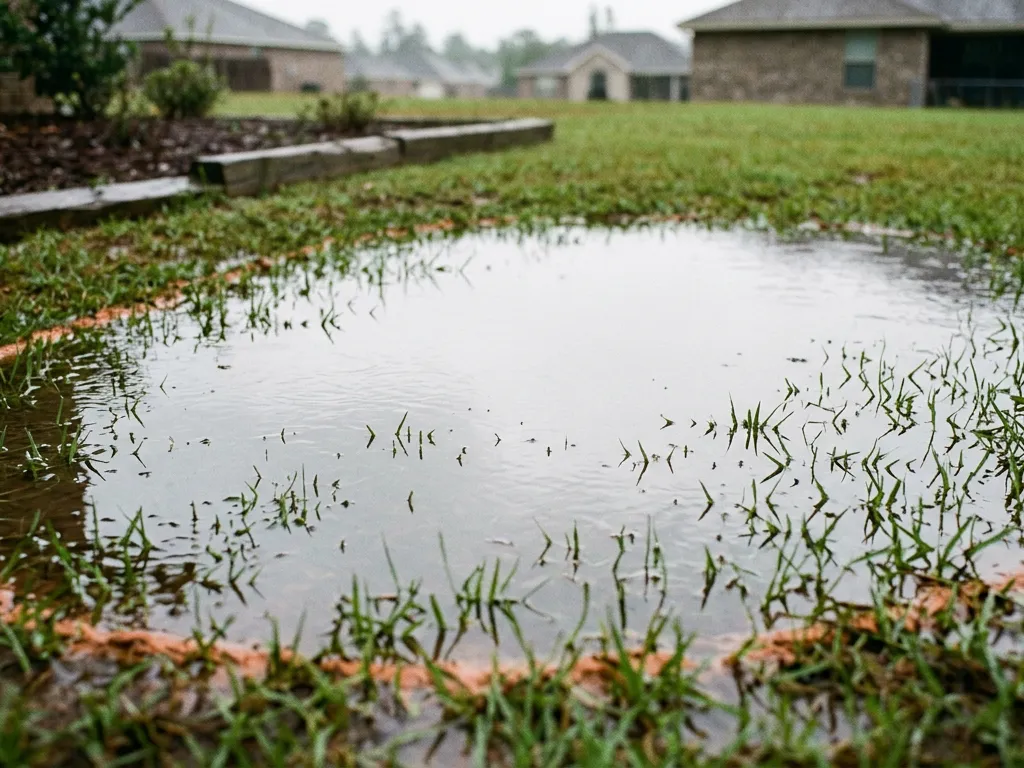
Three causes that look identical from the porch
Grade. Water arrives and cannot leave, because the low point of the yard is where it is sitting and there is no fall out of it. This is the cause people assume, and it is the cause perhaps a third of the time.
Soil. The lot drains fine on the surface and the water still sits, because Red Hills clay under the topsoil is holding it. A yard with this problem can be graded perfectly and stay wet, which is why regrading sometimes fails to fix anything and the homeowner concludes the contractor was incompetent.
Delivery. Somewhere is sending more water than this patch can take: four downspouts on one elevation, a neighbouring lot draining across the line, a driveway acting as a chute, or a seasonally high water table pushing up from below. The yard is not failing, it is being overwhelmed.
The test hole settles the soil question
Dig about a foot down, fill the hole with water, let it drain, fill it again and time the second one. Free draining soil clears in a couple of hours. Clay heavy soil can take most of a day or longer, and that single measurement moves the diagnosis decisively toward a drain rather than a regrade.
It is worth doing in more than one place. The Red Hills clay profile is not uniform, and it is entirely normal to find a lot with fast draining soil at the top of the slope and dense clay at the bottom, which explains a wet spot that seems to have no relationship to the grade.
Reading a yard while it is actually raining
Where water ends up is obvious and mostly unhelpful. Where it comes from, what route it takes and how fast it arrives is the useful information, and it is only visible during a storm. Anyone who can photograph or video their yard mid downpour has collected something genuinely valuable for the site visit.
The specific things worth capturing: which direction the sheet flow moves, whether any downspout is overshooting or overflowing, whether water is entering from a neighbouring property, and how long after the rain stops the puddle is still there.
When the answer is more than one thing
Mixed causes are the norm rather than the exception on older lots here, and they are the reason single fix quotes sometimes disappoint. A yard can have a reversed grade behind the house, clay at eighteen inches, and two downspouts discharging into the same corner, and removing any one of those three leaves a wet yard.
A plan that names all of the causes it found, and says which ones it is addressing and which it is leaving, is more useful than a plan that promises a dry yard without saying why it is currently wet.
Signs this is your problem
- Water is still standing 24 to 48 hours after the rain stopped
- The same patch floods regardless of how heavy the rain was
- Wet ground appears without recent rain, which points at the water table
- More than one area of the yard floods, not a single low point
Standing water: questions
How long is too long for water to stand?
Water gone within a few hours is a yard doing its job. Water still there after twenty four hours is worth investigating, and water still there after forty eight has a cause that will not resolve itself. Standing water also becomes a mosquito consideration at roughly the same point.
Can I work out the cause myself before calling?
To a useful degree, yes. Dig a test hole and time how long it takes to drain, and photograph the yard during the next storm. Those two pieces of information narrow the diagnosis considerably and make the site visit faster.
Why does my yard flood when the one next door does not?
Grading, clay depth and downspout placement all change across a property line, and in the Red Hills the clay profile can differ noticeably between adjacent lots. Identical rainfall, different ground.
Is standing water a threat to the house?
Water sitting against a foundation is worth treating as urgent, since repeated wetting and drying of the soil around a footing contributes to movement and to crawl space moisture. Water standing well out in the lawn is a lawn problem, not a structural one.
Will one fix solve it?
Sometimes. One badly placed downspout can be the whole story. On older lots it is more often two or three causes stacked, and a fix that addresses one of them produces an improvement rather than a solution, which is worth knowing before rather than after.
Does it matter that Tallahassee is one of the rainiest cities in Florida?
It matters a great deal. Around sixty inches a year, much of it in intense summer storms, means a drainage shortfall here gets tested far more often than the same shortfall would in a drier climate. Lots that would be merely imperfect elsewhere fail visibly here.
Find out what is actually wrong
Describe where the water sits and how long it stays. The yard gets walked, the cause gets found, and a written price comes before anything is dug.
Site visits by appointment