Tallahassee Yard Drainage Clay Soil Drainage in Tallahassee, FL
Tallahassee Yard Drainage works on clay soil drainage across Tallahassee and the Red Hills counties around it. This page is about the ground itself, because understanding what sits under the topsoil here explains most of what goes wrong on the lots above it.
The short answer
Most of Florida drains through sand. Tallahassee largely does not. The city sits in the Red Hills, a band of rolling clay country running along the Georgia line, and the dense clay subsoil here holds water instead of passing it down. That single geological fact is behind the majority of standing water complaints in Leon County, and it is why drainage advice written for the rest of the state so often fails here.
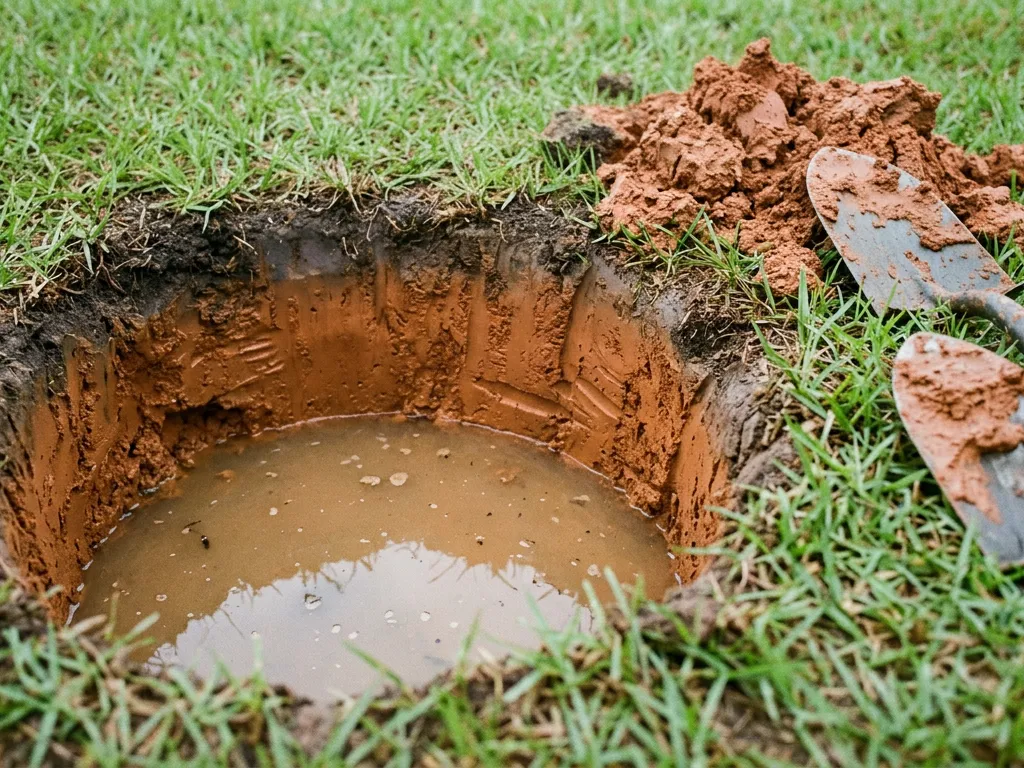
What the Red Hills actually are
The Red Hills region runs across north Florida and into south Georgia, and it is characterised by rolling terrain and reddish, clay rich soils, quite unlike the flat sandy plain that most people picture when they think of Florida. Tallahassee sits in it. The colour comes from iron in the clay, and the drainage behaviour comes from how tightly the particles pack.
Clay particles are orders of magnitude smaller than sand grains and sit far closer together, which leaves very little pore space for water to move through. Water does not refuse to enter clay, it just enters extremely slowly, and during a storm that is functionally the same thing as not entering at all.
The profile is not uniform. Topsoil over clay is the common arrangement, and the depth at which the clay starts varies from lot to lot and sometimes within one lot. South of town, around Woodville, the ground changes character entirely and becomes sandy karst, which drains very differently again.
Why amending the soil does not scale
Working compost and organic matter into clay genuinely improves it, and for a planting bed it is often the right answer. The trouble is depth and area. Amending the top eight inches of a bed changes how that eight inches behaves, while the unamended clay beneath still stops water at the same rate it always did.
Across a whole yard the volume required makes it impractical, and the outcome on a lot with a real drainage problem is a soft amended layer sitting on an impermeable one, which can perch water closer to the surface rather than removing it. Amendment is a horticultural tool. Drainage is a plumbing problem.
Designing around clay instead of fighting it
The productive approach accepts that the water will not go down and gives it somewhere to go sideways. A French drain does exactly that: a void filled route, wrapped so it stays void filled, sloped to an outlet. On clay this is not a premium option, it is generally the only thing that works.
Two details matter more on clay than they would elsewhere. Filter fabric, because fine clay particles will migrate into unwrapped stone and destroy its capacity from inside. And discharge distance, because water released too close to a foundation on clay travels laterally through the soil rather than sinking away.
Plant selection quietly does some of the work too. Turf and planting chosen to tolerate periodically wet feet reduces how much the clay's behaviour actually costs you in appearance, which for some yards means a smaller engineered system is enough.
Signs this is your problem
- Water stands for days on a lot whose grading looks correct
- A hole a foot deep fills and then drains very slowly
- Soil is sticky and dense when wet, hard and cracked when dry
- A previous regrade improved things without solving them
Clay soil drainage: questions
How do I test whether clay is my problem?
Dig a hole around a foot deep, fill it, let it empty, then fill it again and time the second drain. A couple of hours means the soil is working. Most of a day, or standing water still there the next morning, means the clay is the constraint and no amount of surface work will change it.
Is all of Tallahassee clay?
No, and the exception matters. The Red Hills clay dominates the city and the country to the north, but south of town the Woodville Karst Plain is sandy, limestone influenced ground with a high water table and very different behaviour. Crawfordville sits near the transition.
Can I just add sand to clay soil?
This is worth avoiding. Sand mixed into clay in the wrong proportion produces something closer to a very dense, cement like material than to free draining soil. Organic matter improves clay; sand generally does not.
Does clay affect septic systems here too?
Yes, and for the same reason. Slow percolation is a real constraint on drain field design and siting, which is why it comes up on properties outside the city limits. It is a separate matter from yard drainage but it shares a cause.
Why did drainage advice I read online not work in my yard?
A great deal of general Florida drainage advice assumes sandy, fast draining soil and recommends solutions that depend on water soaking in. On Red Hills clay those solutions have nothing to work with, which is why the standard answer here is to route water out rather than help it down.
Find out what is actually wrong
Describe where the water sits and how long it stays. The yard gets walked, the cause gets found, and a written price comes before anything is dug.
Site visits by appointment