
The two fixes people mix up most
Tallahassee Yard Drainage's Guide to French Drain vs Swale in Tallahassee Yards
One is buried and collects water from the soil. The other is on the surface and carries water across it. Choosing the wrong one is the most expensive mistake in drainage.
- Tallahassee, Bradfordville and Crawfordville
- Written price before any digging
- Licensed, insured local contractors
- Priced for Red Hills clay and karst sand
Tallahassee Yard Drainage gets asked this question in some form on most calls: should the yard get a French drain or a swale? The honest answer is that they solve different problems, and a lot of Tallahassee yards need both. This guide explains the difference and how to tell which problem you have, then covers catch basins and dry wells, the two other fixes they are most often compared with.
Choosing a $5,000 French drain to carry surface water a $2,500 swale would have handled means paying double for a system that still overflows in a two-inch July storm.
What each one is
French drain
A trench lined with filter fabric, filled with washed gravel around a perforated pipe, and covered with soil and sod. Water in the surrounding soil seeps into the gravel, enters the pipe and flows to an outlet. It is invisible once finished. See French drain installation.
Swale
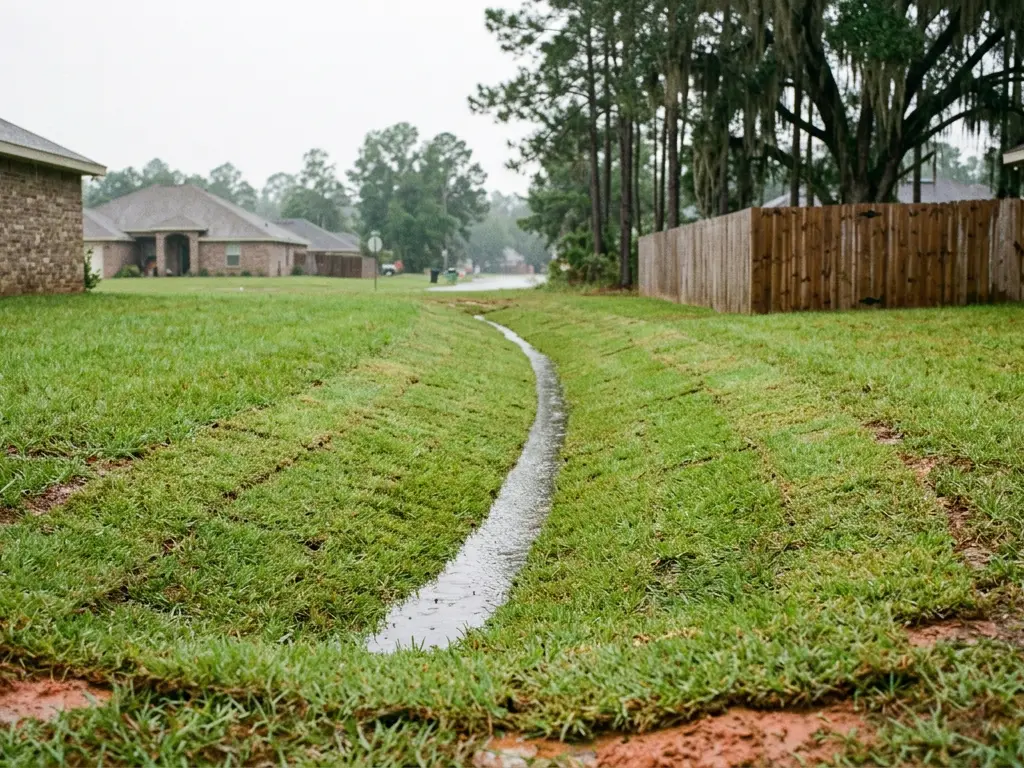
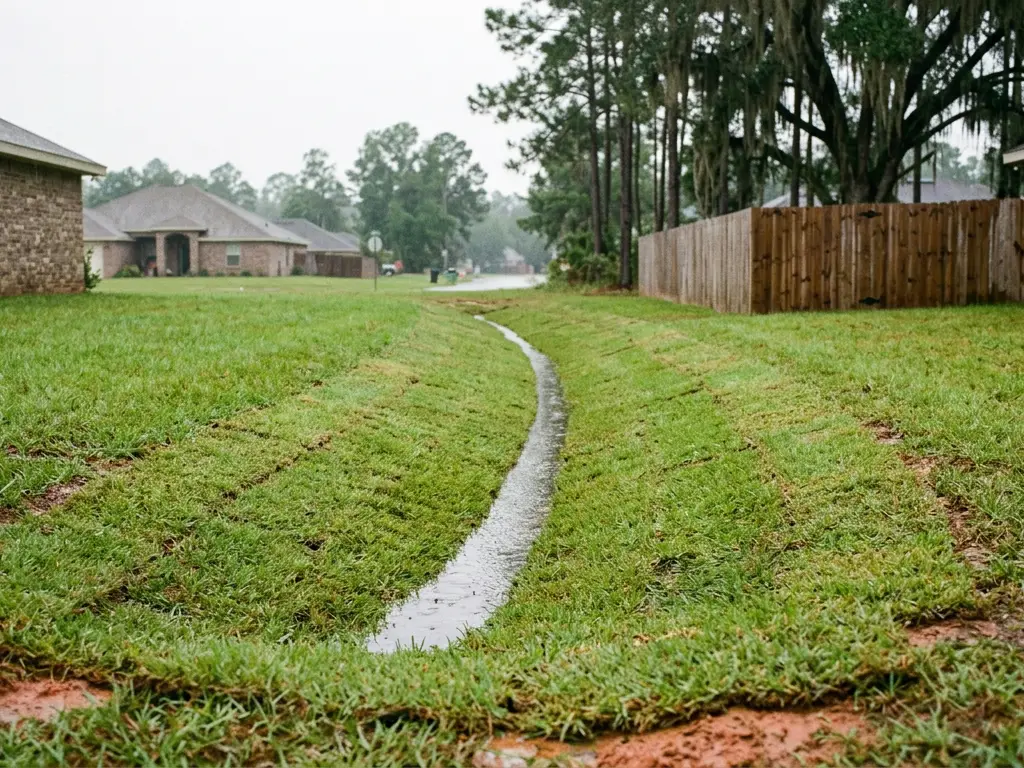
A broad, shallow channel shaped into the lawn, usually grassed, falling gently along its length. Water flowing across the surface is gathered into it and carried to an outlet. It is visible, but on a well-built swale barely so. See drainage swales.
The one question that decides it
Go out during a heavy rain and watch. Can you see the water moving across the ground, in sheets or streams? That is surface water, and surface water is swale work. Or is the ground soggy and spongy with no visible flow, staying wet for days after the surface looks dry, perhaps with water seeping out of a slope? That is subsurface water, and subsurface water is French drain work.
A French drain can catch some surface water through a gravel top, but in a real Tallahassee downpour it is overwhelmed quickly, because water arrives faster than it can soak through the gravel. A swale, meanwhile, does nothing for soil that stays wet from below.
Not sure which of these your yard needs? Describe it on the phone and get a straight answer.
Call (850) 604-5871Side by side
- Handles: French drain, water in the soil; swale, water on the surface.
- Capacity in a big storm: French drain, limited by the pipe and gravel; swale, high, because the channel is open.
- Typical Tallahassee cost: French drain, $30 to $65 per foot, most runs $2,500 to $9,000; swale, $1,500 to $5,000.
- Maintenance: French drain, keep the outlet clear and jet the pipe occasionally; swale, mow it and keep it clear of debris.
- Failure mode: French drain, silting up if built without fabric; swale, erosion if too steep, ponding if too flat.
- Visibility: French drain, none; swale, a gentle dip in the lawn.
Why many Tallahassee yards need both
In the Red Hills, a sloping lot typically receives runoff from uphill in every storm and also has water travelling through the soil along the top of the clay-enriched subsoil. The first is a surface problem and the second is a subsurface one. The durable fix is a swale to carry the storm and a French drain beneath or beside it to dry the soil, both sharing one outlet. On lots in Bradfordville and the north side of town that combination is common.
South of the Cody Scarp the balance shifts. On sandy ground with a high water table, a French drain has a harder time emptying, so surface grading and swales to a roadside ditch do more of the work.
Still not sure which your yard needs?
Describe what you see during a storm. Whether the water is moving on top or sitting underneath decides it in a sentence.
Call (850) 604-5871Living with each one
Over ten years the two ask different things of you. A French drain asks almost nothing, as long as it was built with fabric and a real outlet: keep the emitter or outlet clear, and have a long run near trees jetted every few years. A swale asks for ordinary lawn care. It gets mowed with the rest of the yard, it needs leaves and pine straw cleared out of it in fall, and any bare spot in the channel should be patched before the next storm cuts it deeper. Neither needs power, and neither has moving parts.
French drain vs catch basin
A catch basin is a grated box at a single low point, piped away with solid pipe. It collects surface water that gathers in one spot. A French drain collects soil water along a line. A yard with a pond in one corner wants a catch basin; a yard with a soggy strip wants a drain; a yard with both gets both, tied into one outlet line. See catch basin installation.
Not sure which of these your yard needs? Describe it on the phone and get a straight answer.
Call (850) 604-5871French drain vs dry well
These are not really alternatives. A French drain collects and carries water. A dry well is one possible place to send it, an underground chamber that lets water soak into the soil. In most of the Red Hills a dry well fills and stays full because the clay subsoil absorbs water too slowly, so a French drain there should end at daylight, a swale or a ditch instead. See dry well installation.
Where both have to end
Whichever you choose, the water has to go somewhere legal. Florida's reasonable-use rule for surface water means it cannot simply be sent onto a neighbor, and connections to a curb, ditch or storm inlet in the right of way need a City of Tallahassee, Leon County or Wakulla County permit. Every trench, and a swale is a shallow one, needs a Sunshine 811 locate first.
French drain vs swale questions
Is a French drain or a swale better?
Neither is better in general. A swale handles surface water flowing across a yard; a French drain handles water in the soil. Many yards need both.
Which is cheaper, a swale or a French drain?
In Tallahassee a swale typically costs $1,500 to $5,000, while most French drains run $2,500 to $9,000, so a swale is usually cheaper.
Can a French drain handle surface water?
Only a little. In a heavy storm water arrives faster than it can soak through the gravel, so surface flow needs a swale or catch basin.
What is the difference between a French drain and a catch basin?
A catch basin collects surface water at one low point through a grate. A French drain collects water from the soil along a trench.
What are the signs I need a swale rather than a French drain?
Water you can see flowing across the lawn in sheets or streams during rain, especially coming from uphill or a neighbor's lot.
Talk it through before anyone digs
Describe where the water sits and where it comes from. You will hear which fix fits the yard, what it usually costs, and whether you need one at all.
Call (850) 604-5871