
What goes wrong, and what it costs to put right
Tallahassee Yard Drainage's Guide to 7 French Drain Mistakes That Cost Tallahassee Homeowners
A French drain is simple in principle. Most of the ones that fail do so for one of seven reasons, and nearly all of them are decided before the trench is filled.
- Tallahassee, Bradfordville and Crawfordville
- Written price before any digging
- Licensed, insured local contractors
- Priced for Red Hills clay and karst sand
Tallahassee Yard Drainage sees a steady stream of calls about French drains that were installed and never worked, or worked for a year and stopped. Almost every one traces back to a short list of mistakes. Here they are, in roughly the order they cost Tallahassee homeowners money, with what it takes to put each one right.
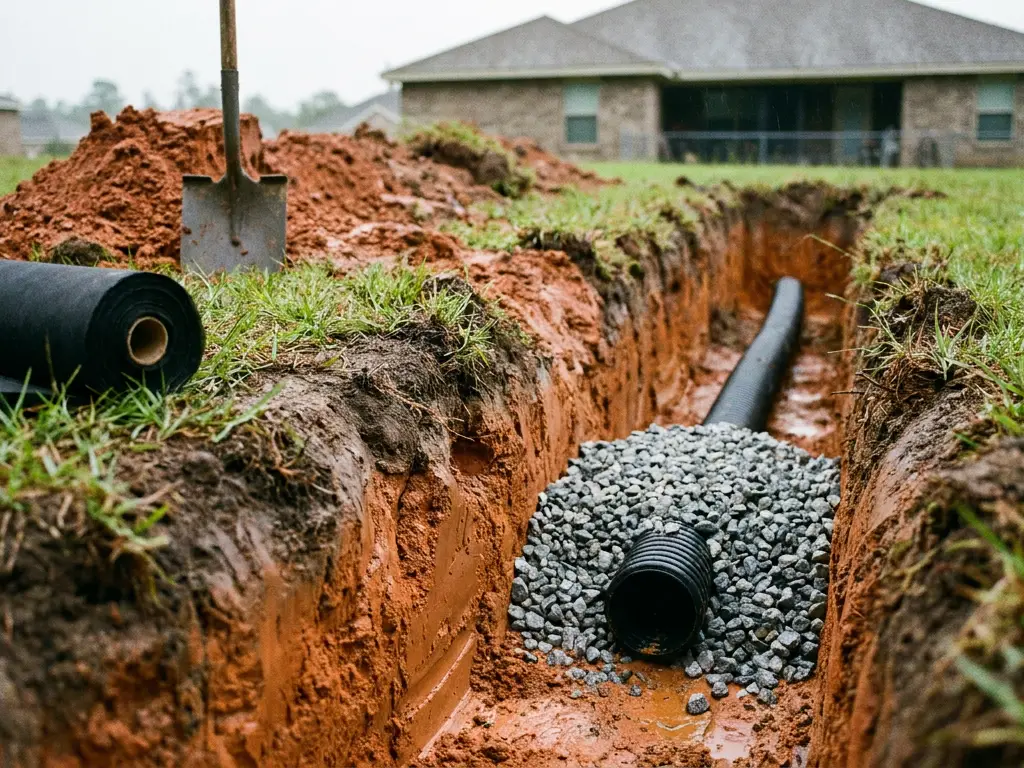
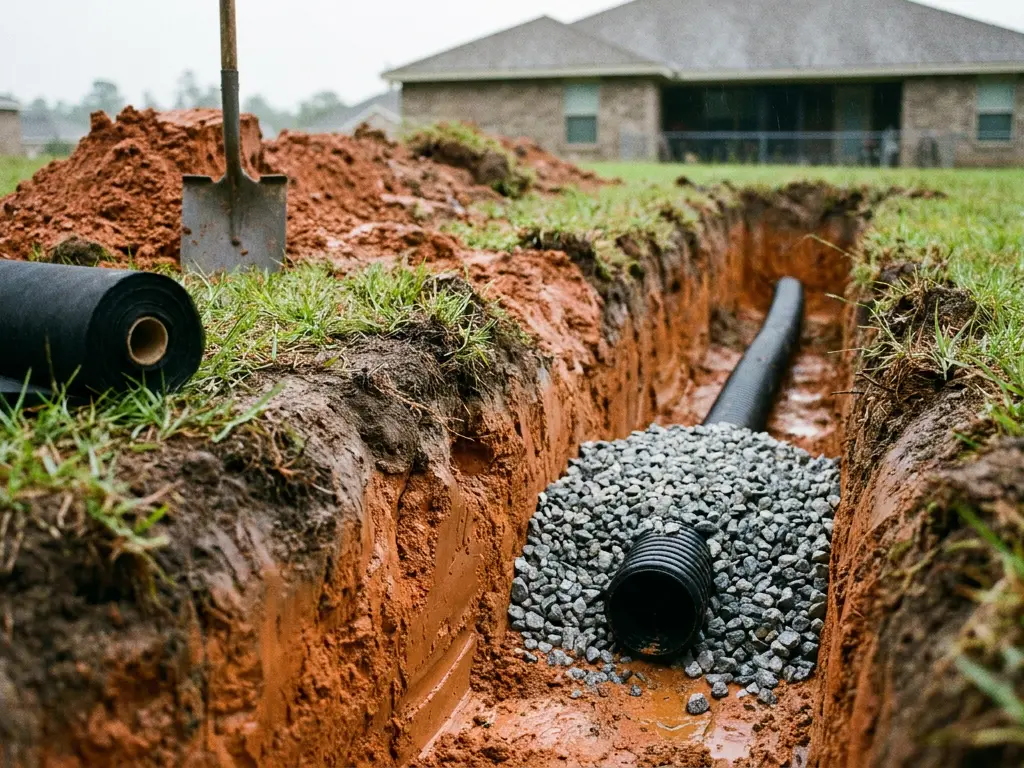
Every mistake on this list saves a few hundred dollars on install day and costs thousands later: a French drain built wrong in Red Hills clay typically gets dug up and rebuilt for $3,000 to $6,000 within a few years.
1. No filter fabric in clay
The single most common failure in Tallahassee. The subsoil across the Red Hills is rich in very fine clay particles. A trench filled with gravel and pipe but not wrapped in non-woven filter fabric lets those particles migrate into the stone with every rain. Over a few seasons the gravel turns into packed red mud and the pipe silts up.
The fix: the affected run has to be dug up and rebuilt with fabric. Jetting clears the pipe but not the stone around it.
2. No real outlet
A French drain moves water from where it is to somewhere lower. If the pipe simply ends in the lawn, or in a gravel pit dug into clay, the water has nowhere to go and the drain fills and stops. This is the mistake behind most "it never worked" calls.
The fix: extend the pipe to real daylight downhill, a swale, a ditch, or a permitted storm connection. Sometimes that means a much longer run, which is why the outlet should be decided before the price.
Not sure which of these your yard needs? Describe it on the phone and get a straight answer.
Call (850) 604-58713. Not enough fall, or a belly in the pipe
The pipe needs a steady slope, at least about one percent, to keep water moving. A trench dug by eye across rolling ground often has a low spot in the middle where water sits and sediment collects.
The fix: reset the pipe to a consistent fall, checked with a level or laser, and test it with a hose before closing the trench.
4. Piping the downspouts straight into it
Roof water arrives in huge volumes during a storm and carries shingle grit and leaves. Connected straight into a French drain, it overloads the drain, pushes water back out through the perforations into the soil, and fills the pipe with debris.
The fix: run downspouts in their own solid pipe. They can share a trench and an outlet, but not a pipe.
Got a drain that never worked?
It is almost always one of these seven, and most can be fixed without starting over. Call and describe what it does in a storm.
Call (850) 604-58715. Using a French drain for surface water
If you can watch the water flowing across the yard in a storm, that is surface water. A French drain can only absorb it as fast as it soaks through the gravel, which in a Tallahassee downpour is far slower than it arrives. The drain overflows and the homeowner concludes it failed.
The fix: a swale or regrade to carry surface water, with the French drain kept for water in the soil. See French drain vs swale.
6. Cheap corrugated pipe and no cleanout
Thin corrugated coil is cheap and quick to lay. It also crushes under backfill, sags into bellies, traps sediment in its ridges and is hard to clean. Without a cleanout at the high end, there is no way to flush the line when it needs it.
The fix: rigid smooth-wall pipe on long or important runs, and a cleanout at the high end.
Not sure which of these your yard needs? Describe it on the phone and get a straight answer.
Call (850) 604-58717. Ignoring the neighbor, the utilities and the permit
Three separate mistakes with the same root. Sending the water onto a neighbor can create liability under Florida's reasonable-use rule for surface water. Digging without a Sunshine 811 locate, which needs at least two full business days of notice, risks a cut gas or power line and the bill for it. And tying into a curb or ditch in the right of way without a City of Tallahassee, Leon County or Wakulla County permit can mean being told to remove it.
The fix: decide the outlet on paper, locate utilities, and pull the permit if the right of way is involved. All three before digging.
What putting a mistake right usually costs
The cheap fixes are the outlet ones: uncovering a buried pop-up emitter or replacing a crushed one runs $200 to $500. A camera run and jetting to find and clear a blockage runs $250 to $650. The expensive fixes are the ones built into the trench: missing fabric, a belly in the pipe or the wrong kind of drain for the water. Rebuilding a failed section typically runs $1,200 to $4,000, and a drain that was the wrong choice from the start has to be replaced with the right one at full price. That is why nearly all of the money in this list is decided before the trench is filled.
A note for yards south of town
On sandy ground with a high water table, around Woodville and Crawfordville, there is an eighth mistake: designing a French drain that relies on the ground absorbing water. In a wet season the ground is already full. Drains there must reach an outlet lower than themselves, usually the roadside ditch.
How to avoid all seven
Ask the contractor, before signing: where does the water go, and is that legal? Is the trench wrapped in fabric? What pipe, and is there a cleanout? Are the downspouts on separate pipe? Will I see it flow-tested before it is buried? Who is calling 811 and pulling any permit? A contractor who answers all six clearly is unlikely to make any of these mistakes. The French drain installation page walks through the build properly.
French drain mistake questions
Why did my French drain stop working?
Most often silt from a trench built without filter fabric, a blocked or missing outlet, a belly in the pipe, or tree roots.
Do French drains need filter fabric?
In Tallahassee's clay-rich subsoil, yes. Without non-woven fabric, fine clay migrates into the gravel and clogs it.
Can I connect my downspouts to my French drain?
Not into the same pipe. Run downspouts in solid pipe, which can share the trench and outlet.
What is the most common French drain mistake?
In Tallahassee, leaving out filter fabric in clay, closely followed by building a drain with no real outlet.
What are the signs my French drain was installed wrong?
It never worked, it overflows in every storm, the outlet never runs, or the ground over it stays soggy.
Talk it through before anyone digs
Describe where the water sits and where it comes from. You will hear which fix fits the yard, what it usually costs, and whether you need one at all.
Call (850) 604-5871